Evernote → Apple Notes
Move Evernote notebooks to Apple Notes.
Export notebook-sized ENEX files on Mac or Windows, then use Apple Notes on a Mac to import them. Keep an independent HTML archive for anything the new app does not reproduce.
macOS & Windows · No card needed · Updated
Use Apple Notes’ ENEX import route
Apple documents ENEX import in Notes on Mac. One ENEX file can contain many notes, and each imported note becomes a new note. That makes a notebook-sized file a practical unit for testing and checking the result.
This is a file-based workflow: Evernote Backup Tool creates the archive; Apple Notes performs the import. You do not need to give the backup app access to an Apple ID. Choose a test destination folder before importing, and retain the original ENEX files after the move.
Apple explicitly warns that attachments or features unsupported by Notes will not be imported. “Attachments included in the export” and “every attachment supported in Notes” are different claims. Check your important PDFs, scans and embedded documents.
Start with a local copy of your account
- Install Evernote Backup Tool on a Mac or Windows computer. Choose a disk with enough space for the database, exported notes and attachments.
- Connect your Evernote account through browser authorization. For Yinxiang, use the separate connection settings in the app.
- Sync the account and review the local verification report. Retry incomplete downloads before treating the archive as complete.
- Export a representative sample of up to 50 different notes, including images, a PDF, tables and linked notes. Check those files in your destination app before buying a pack for the rest.
Ordinary note and attachment sync connects to the service API; you do not need Evernote’s desktop app for that workflow. This is a desktop tool, so a phone or browser alone cannot run the backup. Task and reminder synchronization has separate authentication requirements and should not be assumed to follow the ordinary-note path.
Synchronization needs Internet. Once the required content is stored locally, file export works offline. Shared content and other special account areas remain subject to the app’s supported scope and your account permissions.
Export one ENEX file per notebook
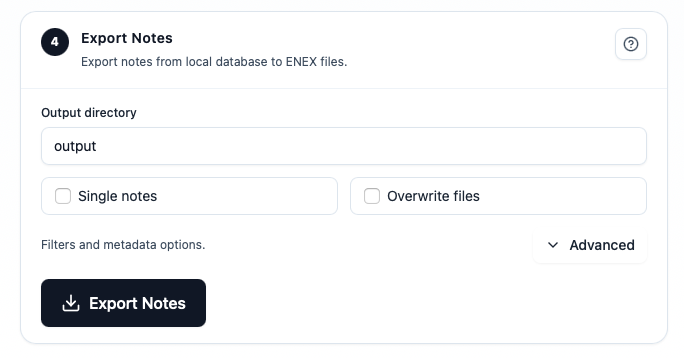
For notebook-sized ENEX output, leave Single notes disabled. Default export writes a file named from each non-empty notebook, inside a stack directory when present. If a filename contains unsupported characters it is adjusted; an existing filename can also receive a suffix when overwrite is disabled.
export/
├── Work stack/
│   ├── Research.enex
│   └── Meetings.enex
└── Personal.enex
This is an illustrative file tree. Review the actual filenames and your selected export scope. A stack directory is local organization, not a guarantee that Notes will recreate an equivalent folder hierarchy from the ENEX file.
ENEX stores titles, created and updated timestamps, tags and available source URLs. Storing those fields in ENEX does not guarantee that a destination app imports every field. Keep the original files so you can check anything the new app omits.
Export HTML alongside ENEX if you want a readable comparison copy. Move or back up its complete directory, including the shared resources.
Import on a Mac and name the resulting folder
- Transfer the ENEX files to your Mac if you exported them on Windows.
- Open Notes and select a folder under iCloud or On My Mac.
- Choose File → Import to Notes.
- Select one notebook’s ENEX file, click Import, and confirm the import.
- Find the resulting Imported Notes folder. Check the contents and give the folder a useful name matching the source notebook.
- Repeat with the remaining notebook files after the sample passes your checks.
Apple’s import interface can accept multiple files, but one notebook at a time makes it easier to track folder names and reconcile counts. Re-importing the same file can create duplicates; keep a simple record of which files have already been imported.
Follow Apple’s current import instructions if menu wording differs in your system version.
Choose between iCloud and On My Mac
When you choose iCloud for the import, the Imported Notes folder appears in the iCloud section. With the same Apple Account and Notes enabled in iCloud, that is the route for accessing the imported library on your other supported devices. An import into On My Mac stays in local Mac storage unless you move it.
Let synchronization finish and inspect a sample on your iPhone or iPad before treating the cross-device copy as complete. iCloud storage and network availability are separate from the backup tool’s note credits.
Apple also describes sharing supported files from the Files app to Notes on iPhone and iPad. That is an alternative file route, not the same desktop bulk-import workflow. The backup app itself still requires a Mac or Windows computer.
Markdown is another option on newer systems
Apple supports Markdown import on macOS Tahoe 26, iOS 26, iPadOS 26 and later. On Mac, Notes offers File → Import Markdown; Apple also documents a preserve-folder-structure option in its general file/folder import workflow.
Whether this tool’s Markdown layout becomes the folder structure and embedded resources you want still needs a sample import. Its images and documents live in shared folders outside each notebook directory. Do not assume importing only the Notebooks folder will also import those resources.
The exporter writes YAML properties for several Evernote fields, but Apple Notes controls whether its Markdown importer creates equivalent dates, tags or source URL properties. Start with ENEX when you want Apple Notes’ Evernote import path, and compare Markdown only if you need it.
Check content, dates and duplicate notes
- Record the note count represented by the sample ENEX, then compare it with the newly created notes.
- Inspect images, PDFs, scans, tables and checklists in Notes.
- Check the dates shown in Notes against the original; do not infer destination date preservation from fields present in ENEX.
- Test an internal Evernote link. This tool does not provide Apple Notes link rewriting.
- Review tags, encrypted content and reminders individually. Do not rely on a migration to decrypt or recreate unsupported features.
- Keep the ENEX and HTML archives on separate storage, even after import succeeds.
The route here follows Apple’s documented file import. It is not a claim that every attachment, timestamp or format has passed an end-to-end Apple Notes test. Use the backup preparation guide for choosing a preservation copy before the move.
One library. Every export format.
Pay once. Choose by note count.
Try 50 different notes and their attachments free, with no card. Full account sync and the local verification report are free before you choose a pack.
Up to 1,000 notes
$29
USD · one-time purchase
Up to 10,000 notes
$49
USD · one-time purchase
Up to 50,000 notes
$79
USD · one-time purchase
- ENEX, HTML & Markdown · HTML index & search
- All attachments for your selected notes
- Packs stack and never expire
- A note counts once, across formats and repeat exports
Trial exports count toward the paid total: after exporting 50 trial notes, a 1,000-note pack leaves room for 950 new notes. Re-exporting those notes in another format uses no additional credit.
Purchased packs share one quota across your devices. Previously trial-exported notes count toward your purchased total. The purchased version and its minor updates are included; future major versions are not. Existing Backup and Migration licenses keep their original unlimited-note entitlements. Contact support if you need help with an existing license.
Payments by Paddle. Refunds within 14 days for functional or compatibility issues. Destination app limits still apply; check a sample before moving your library.
Questions before you move
Do I have to use a Mac?
The bulk ENEX instructions here use Notes on Mac. The backup/export can run on Mac or Windows. Apple also documents file sharing into Notes on iPhone and iPad, but that is a different workflow from this desktop import.
Will the notebook names become Apple Notes folders automatically?
Do not rely on that. Export filenames identify your source notebooks, while Notes creates Imported Notes folders. Import a notebook, verify it, and rename the folder before continuing.
Are all attachments guaranteed to import?
No. Apple says unsupported attachments or features are not imported. Keep ENEX and a readable HTML copy, then check the important files in Notes.
Can I use Markdown instead?
Supported newer Apple systems can import Markdown, but this exporter’s shared attachment layout and resulting folders need a sample test. The exporter writes YAML properties, though Apple Notes may not import every field as a matching property.
Does the tool split large ENEX files for Apple Notes?
No. It can export by notebook or as individual notes, but it does not currently split notebook files into batches of a selected size.
Official references
Destination steps and limits were checked against these documents. Apple Notes and UpNote imports have not been independently tested with this tool’s export.
Find your next workflow